What is Biofeedback and How Does It Help With Stress Regulation?
Stress is something we all experience, but it doesn’t only exist in our thoughts. When you’re preparing for an important meeting, dealing with a difficult situation, or simply feeling overwhelmed by everyday demands, your body responds too. Your heart may begin beating faster, your breathing can change, your muscles may tense, or your hands may become sweaty, all before you consciously recognize how stressed you are.
These physical responses are part of the body’s natural reaction to stress. But what if you could actually see those changes happening in real time? That’s where Biofeedback comes in. Biofeedback provides information about what’s happening inside your body, helping you recognize your individual stress responses and practice ways to better regulate them.
What Is Biofeedback?
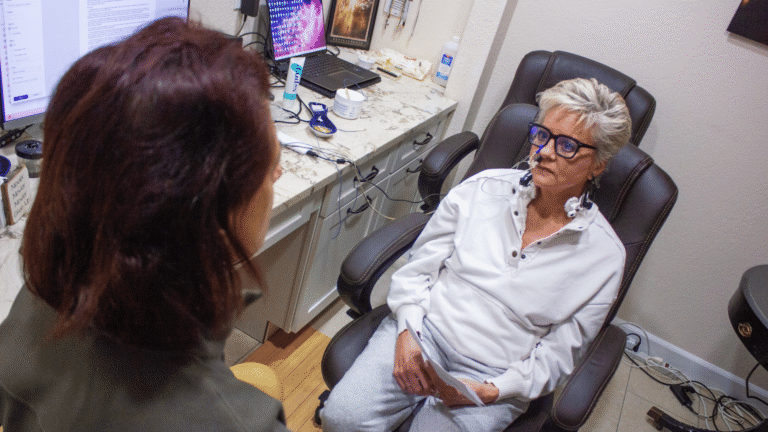
Biofeedback uses sensors to measure physiological processes that normally happen without much conscious thought. Depending on the type of training, this can include heart rate, breathing, muscle tension, skin temperature, and skin conductance. That information is then displayed in real time, allowing you to see how your body responds to different situations and techniques.
Instead of simply thinking, “I feel stressed,” Biofeedback gives you another layer of information. You may be able to see your heart rate change, notice patterns in your breathing, or recognize tension you weren’t consciously aware you were holding. This increased awareness can help connect what you’re feeling mentally with what is happening physically.
If you’re curious about what this actually looks like in practice, our guide to what happens during a Biofeedback session walks through the process from beginning to end.
From Recognizing Stress to Regulating It
Seeing your body’s response is only one part of Biofeedback. The next step is learning what you can do with that information.
During a Biofeedback session, you may practice techniques such as paced breathing, guided relaxation, visualization, or mindfulness while observing how your body responds. For example, as you adjust your breathing, you may be able to watch corresponding changes in your physiological data. This creates a feedback loop between what you’re doing and how your body is responding.
Over time, the goal is to become more familiar with your own patterns. You begin to recognize what stress looks and feels like in your body and practice strategies that can help you return to a more regulated state. These skills are designed to extend beyond the Biofeedback session, giving you tools you can use when stressful situations arise in everyday life.
This connection between stress and physical responses is also why understanding how stress affects the body can be so valuable. Stress can look different from person to person, and becoming aware of your own patterns is an important part of learning how to respond to them.
What Does Biofeedback Look Like at ACFN?
At the Arizona Center for Neurofeedback, Biofeedback training is personalized to the individual rather than approached as a one-size-fits-all process. Dr. Lorene Petta and the ACFN team use physiological information alongside each client’s goals to guide training and help clients better understand their body’s responses.
The experience is active and interactive. Rather than simply being told to “relax” or “manage your stress,” you’re able to observe your body’s response while practicing regulation strategies. That real-time information can make something that often feels invisible—your body’s stress response—much easier to recognize and understand.
Understanding Your Stress Response With a Physiological Stress Profile
At ACFN, one way we can better understand an individual’s stress response is through the Physiological Stress Profile, or PSP. During this assessment, sensors measure multiple physiological systems, such as muscle tension, heart rate and heart rate variability, breathing patterns, skin temperature, and skin conductance, while looking at how the body responds at rest, during brief stressors, and during recovery. This can help identify which systems react most strongly, where stress may be showing up physically, and how quickly the body returns toward baseline. That information can then help guide Biofeedback training in a more individualized way, allowing sessions to focus on the physiological responses that are most relevant to each person.
Building Greater Awareness of Your Stress Response
Stress is a normal part of life, and the goal isn’t to eliminate every stressful moment. Instead, Biofeedback can provide a way to better understand how your body responds when stress occurs and practice strategies for regulating those responses.
Learning to recognize your own patterns can be an important first step. The more aware you become of what stress looks like in your body, the better equipped you may be to recognize when you’re becoming activated and intentionally use the regulation skills you’ve practiced.
Interested in learning more? Explore Biofeedback Therapy in Scottsdale or contact the ACFN team to learn whether Biofeedback may be appropriate for your individual goals.